April 29, 2011

Superman . . . Because I Just Had to Say SOMETHING . . .

Back in the late '70's and the early years of my life, this was Superman. It wasn't until I grew up that I understood how cynical things were in that time and that part of what made Superman and Star Wars, as movies, successful was the earnestness of optimism.

So there's a whole lot of talk about Superman renouncing his American citizenship. It's funny -- I was just thinking about how Superman really represents the best of America. He's an immigrant, he believes in good and evil, he believes in using his powers for good, and he's okay looking like a square doing it.

And he stands for "the American way", which is, simply put: "We hold these truths to be self-evident, that all men are created equal, that they are endowed by their Creator with certain unalienable Rights, that among these are Life, Liberty and the pursuit of Happiness."


And now he's saying:

Followed up with this:


Now, I read the story in question. It's an okay story. Superman decides to give up the "American citizenship" because a Middle East government took his participation in a peace rally as an endorsement of the American government in the peace movement. So Supes decides to give up his citizenship to avoid things like that in the future, with his reasoning in the above panel.

In other words, Superman is now a citizen of the world. And the truth is this: Superman, in the stories he inhabits and also in the real world, is a symbol. A symbol of "truth" and "justice" and the "American way". Remember when, in Superman Returns, they didn't say "and the American way"?

This is nothing new.

This says nothing about the symbol Superman has become. It says everything about the people in charge of the symbol.

The same could be said about America. America is a symbol, but what America actually is says more about the people in charge of the symbol than the ideal the symbol represents. The American dream, the American ideal -- these are good things. It's the people who make it look bad.

Anyway, the American way isn't enough? I guess it depends on what you see as the American way. Corporate greed? Political corruption?

Or "truth" and "justice"?

America's not perfect. But the things America stands for? They are ideas worth standing for. Maybe not if you're from Krypton, I guess . . .

~ Ben

PS -- The fact that this is causing a stir, does that mean that comics are still relevent?

PPS -- Is Clark Kent retaining his citizenship? That changes the story a bit if he does, don't you think?

April 25, 2011

What Stargate's "Demise" Can Teach Us About Life (and Storytelling)


If you know me, you know I am a big fan of Stargate Universe. This is obvious if you follow my tweets (I'm @whisperingloon on Twitter) or if you listen to my podcast (The Fanboy Tollbooth), especially the most recent episode and it's "The Adventures of Ben and Lou, Lou Bitterman" segments, which features a sci-fi fanboy dealing with Lost withdrawal and finding comfort in a Lost replacement show: Stargate Universe.

Spoiler alert for "Ben and Lou": Stargate Universe was canceled.

Which is what this blog post is about. No, not Lou. Stargate Universe. And the universe of Stargate.

Here's the deal, for those who are unfamiliar with Stargate. I'm going to avoid arcane details for people who could care less about the Stargate franchise, because this blog post is both about Stargate (which is really only for geeks -- which I am) and the art of storytelling and how it relates to life (which is really only for humans -- which I am as well).

But you do need some background. There have been three Stargate series (although I count them as four because I'm a geek). Series 1 is Stargate SG-1, which ran for 10 seasons. To me, the last two seasons were a new series because it featured two new cast members in lead positions and had a completely different story arc going. Meanwhile, during the last few seasons of Stargate SG-1, Stargate: Atlantis was also on the air. It ran for five seasons. Finally, after an abrupt cancelation of Stargate: Atlantis, a third Stargate series, Stargate: Universe, was launched.

So what happened? Well, much has been written about how Stargate died and how it didn't pull in the numbers and all of that, and how science fiction fans are not watching television live, when advertising matters, but instead are watching online or recording it to watch later, when they can skip advertising. Much more will be written about the issue in more general terms, because while science fiction is ahead of the curve in these matters, all of Hollywood, from movie makers to television creators, are trying to figure this out. And they are a lot smarter than me, so I'm not going to figure this out.

Okay, they're a lot richer than me anyway.

No, I'm looking at this with an eye toward storytelling and connecting with your audience. Again, without getting into the arcane details, here's what happened with the different Stargate series:

 Almost the entire "main" cast from the ten seasons of Stagate

Stargate: SG-1 always seemed to be ready to be canceled, to me anyway. So the show was very episodic, with self-contained stories, but as they went they started doing some longer story arcs that resolved themselves at the end of the season, when they thought they'd be canceled. Now, I don't know if that is true, because I only started really watching Stargate last summer. This is just my impression. But a number of seasons have season finales that would have made for very satisfying series finales. Toward the end of the series, though, the season finales started becoming big cliffhangers. Like "how will the universe survive?" type cliffhangers. And after one of those cliffhangers, at the end of season 10, Stargate: SG-1 was canceled. But no fear, the storyline was resolved in a very well made direct-to-DVD movie. And then, to top it off, they made a second direct-to-DVD film, a stand alone movie that gave a satisfying send off to some of the characters. Another direct-to-DVD movie was planned . . . more on that a few paragraphs in the future.
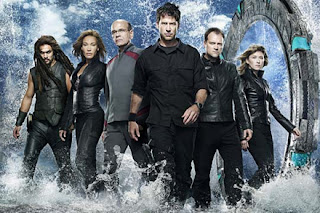
Love this image of the Stargate: Atlantis cast. Can you tell that Atlantis had something to do with water?

Stargate: Atlantis is much more cut and dry. Every season ended on a cliffhanger, and they were told that Stargate: Atlantis was going to be canceled and they had just enough time to make their final episode serve as both a sort of conclusion to the show and a sort of cliffhanger. And the cliffhanger was going to be resolved in a direct-to-DVD movie . . . more on that a few paragraphs down.

 Stargate: Universe's Lost-like ensemble cast

Stargate: Universe was even MORE cut and dry. Less space opera fantasy and more Lost-like or Battlestar Galactica-like, it was a continuing story that was meant to be more gritty and more "real". Very few episodes were just stand alone episodes. Instead, you had to watch every episode to make sense of what was going on. Ratings got lower and lower . . . and then, after season 2 was in full swing and had pretty much been set in stone, Stargate: Universe was canceled. The finale airs next Tuesday, and it is supposed to end on a cliffhanger. (I've heard someone say that it would either serve as an exciting cliffhanger or a bittersweet finale, or something similar. we'll find out next week.)

Of course.

So the suggestion of a direct-to-DVD or direct-to-digital download has been floated around. Something that would give some closure to the novel-like storytelling used for Stargate: Universe. But it was just announced that MGM has officially stated it will not happen, and now sets are being struck and offices cleared out.

This means that the Stargate: SG-1 movie, which was supposed to be an incredible adventure to send off the main character of Stargate (Richard Dean Anderson's character O'Neil -- can't remember if it's one "L" or two -- who wasn't in the first DVD movie and was a minor character in the second) is dead. This means that the Stargate: Atlantis movie, which was supposed to wrap up any dangling plot threads (and there were a few) is dead. This means the Stargate: Universe movie which would have completed the planned plot (three seasons worth!) is dead.

It also means no resolution for the Saturday morning Stargate show, something no one cares about anyway (although I strangely want to see it because of the intense negativity toward it)


This makes me sad. For two reasons. One, I like the story and the characters! A lot! Two, I've had comic series canceled on ME before, before I had a chance to finish the story I wanted to tell, and that hurts! It happened with ArmorQuest (although I've had a chance to revisit that, and more AQ stories in in process as we speak) and it happened on Lullaby and The Imaginaries. Like the Stargate: Universe people, I dream of a chance to make the comic book version of a direct-to-DVD movie . . . perhaps just 48 pages to complete Alice and her fellowship's quest in Lullaby or 48 pages to complete Tanner and Greatman's mission. So far as I know, that chance will never come.

But on the flip side, ending the Stargate franchise like this is, in a way, satisfying to me. The more I thought about it, the more "real" this felt. And not in the way that Stargate: Universe was supposed to be more "real" because it was all gritty.

 Stargate: Universe also boasted some of the best and most beautiful TV sci-fi visual effects

I understand that a satisfaction comes from a completed story. There is something in human nature that wants an ending for a story, and especially wants a satisfying ending to a story. I do not know exactly why this is. I have some ideas, mostly philosophical (in the loosest sense of the word) and religious, and maybe just a little bit psychological . . . but only accidentally. As humans, we want to see justice. We want to see people we care about (and characters we care about) prevail. We want to see people face challenges and overcome them. We want to be encouraged that there is a happy ending to all this strife. (Because, as I believe, there IS in truth a happy ending to all this strife.) This is when we are watching the news, watching our friends, and watching our stories.

So, for Stargate fans, when they watched the characters they grew to love on Stargate: SG-1, they were glad to see the heroes beat the bad guys and overcome their personal issues.

And when they watched the characters they grew to love on Stargate: Atlantis, they were sort of glad to see some conclusion to the problems those characters faced, even if there were some lingering issues.

And when they watch the characters they grew to love on Stargate: Universe (admittedly, fewer Stargate fans seemed to love these character, partly because they were harder to love since they weren't as heroic or perfect) they aren't going to get a chance to see them overcome their main conflicts. (Although, in reference to the last parenthetical, there were a LOT more conflicts and the characters have had to make greater strides to overcome their problems and some problems were, indeed, overcome.)

 No more new journeys through the gate to explore strange new worlds and seek out new . . . sorry

But here's what I like about the Stargate franchise going out like this: it's a lot like watching the people in our lives. Life doesn't wrap up a character arc in a nice bow and then roll credits. No, we overcome a problem and then face another or perhaps the other problem comes back to bite us. And so things that I have seen people complain about in Stargate: Universe, and things that bugged me, don't anymore. For example, in Stargate: Universe, characters from the other two series have shown up. And they've shown up in ways that are a little vague. One character was promoted to command a starship. Another character has become the "big boss", having been promoted to general. Another character, who used to be a "suit" (in SG-1) and was made into an "officer" (of sorts, in Atlantis) showed up as a "suit" again in Universe. How? Why? They never said. Meanwhile, another character shows up and very little seems to have changed. And in the meantime, the crew who make up the main cast of Stargate: Universe? Their story is either going to have a bittersweet ending or just be forever a cliffhanger.

In other words, here's what we can take away from Stargate: Universe:

Life goes on. No, I don't mean that in the William Shatner telling Trekkies to "get a life" sense. And I don't mean "you show was canceled, but don't worry, life goes on".

I mean that "life goes on" has become the THEME of the entire franchise.

People grow.

Challenges come and go. And come. And go. And . . .

There's only one set of end credits.

Now, for some these kind of statements may strike a negative chord. For others, it's a positive one. And for others, it's bittersweet. But this is the theme of the franchise, and like any theme of any story, what the audience does with it is up to the individuals of the audience.

Am I reading too much into a science fiction fantasy? Perhaps. Is this what the creators intended people to think about? I doubt it.

But this IS what science fiction is for, isn't it? To make us think about our world and our place in it? Come to think of it, that's what all storytelling is about.

This is a situation where the theme is unintentional, I think. But, like any story, the theme must be grappled with (or ignored) by the receiver of the story. And I think that too often, storytellers forget that the themes of their stories do connect with the readers or viewers. Conversely, sometimes I think storytellers think too much about their themes, forcing a theme that's not there and missing the theme that has appeared.

 Maybe Stargate will get some sort of hipper, edgier reboot?

I'll still be interested if they do a new Stargate series or movie . . . and if they ever came knocking on my door to ask me to help them out with a Stargate: Universe comic, I'd not hesitate to say yes. But unless they REALLY botch next week's episode I have a feeling that even if the plot is left hanging, I'll have a good feeling about the franchise.

Until then, I have two more episodes of Stargate: Universe to watch. (Yeah, I would be watching as I write this, but I watch it using iTunes . . . so not only do I have to wait until the day after the show airs, I'm also one of the fans who contributed to its demise by not watching it live . . .)

~ Ben

UPDATE: The third to last episode, "Epilogue", could have (with just a few tweaks) been the final episode of the series. And the whole "life goes on" aspect of things I was talking about was directly addressed in the episode.

2nd UPDATE: The penultimate episode, "Blockade", was tense and emotional and exciting and satisfying. This series just kept getting better and better, especially this season.

LAST UPDATE: There is NO way the producers and creators did not know they were facing cancellation when they wrote the finale. In fact, it felt to me like the episode itself, when the characters were talking about a life or death situation they faced, it was almost like they were talking ABOUT the show. And it ended as I hoped . . . (without spoiling it for you) it ended with the implication that the characters have more stories in front of them, but we just won't see them . . . for now.

April 22, 2011

THE WAY OF THE WRITER: Some Under 140 Character Thoughts on Writing


Here's a collection of some of my Tweets on writing. I'm @whisperingloon on Twitter, and I usually tweet about writing, comics, and movies. You know, geek stuff.

As a creator, don't ignore negative criticism. Ignore negative critics. There's a BIG difference.

I've found as a comic book writer, I learn MORE from actually drawing my simplistic little comics. 24 Hour Comic Day was a GREAT boon to me.

Drawing, however awfully, pushes me to think like an artist. So when I script for an artist, I've walked a few miles in their shoes.

Ugh. Not a good sign when the WRITER is bored by the story ... time to take a step back and start over, methinks.

Best tool for great comics: EDITORS
Dragons! Big 'splosions! Swords! Mechanical armor! I love my job! Some days more than others. This is one of those days more than others! :)

In the days of ink and scroll the only hard drive crash you had to worry about was a club to the head or insanity. So I guess I have it good

Worst part about freelancing: Being told outright you don't get the job A. b/c you're not good enough or B. b/c you're not important enough. <-- That tweet followed by this one --> I should have a thicker skin by now, but I still don't. <-- which was followed by this one --> There's got to be some sort of cream that can do it. Probably prescription only, tho. :)

These were all posted on the same day:

To writers: If you give a character dialogue in a panel make sure to actually mention that character in the panel description. <-- That tweet followed by this one --> To artists: writers are sometimes forgetful, so remember to look at the dialogue to see if you need to draw someone in a panel

EVERY page should end in a "mini-cliffhanger" to take readers to the next page.

The page doesn't have to end with someone's life in danger. Just give the reader a reason to want to know what's next.

Your page could end with a question in dialogue. An unexpected event. Something to push the reader to keep reading.

Think of the end of each page (esp. odd numbered) like the commercial break of a TV show. Make readers curious what's next.

And these were also all posted on the same day (it's about writing for comics, but there's a lot that can be applied to prose and film):

some people say a comic is like a movie mixed with a novel. It's not.
a comic book is like a movie mixed w/ poetry. Make every word count. Each line should push your plot forward.

each action and line of dialogue should reveal something about your characters.

long conversations are easy/lazy. Edit yourself. Push yourself to reveal the same thing in fewer words.

& make sure something visual is going on. Movement, setting, or action. Point OR counterpoint to the dialogue.

Long dialogue? Short? There is no right or wrong. What's best for the story? Strive for that.

You may love a bit of dialogue, but let it go to serve story/characters/pacing. That's what readers care about.

Edit yourself. Push yourself. Have someone else edit you (very important!). Ask & answer hard questions. Repeat.

Back to solo tweets:

Overweight. Scruffy. Wearing a black t-shirt ... w/ a comic book character on it. I'm not doing the comic book writer stereotype any favors.

And from my alter-ego, Professor Negatron:

Tip #1: The bigger the explosions, the less character development you actually need.

Tip #2: Snappy, semi-witty dialogue is easier than character driven dialogue, so use it often. Or only!

~ Ben 
    

April 21, 2011

Dinosaurs and Fraggles (more thoughts about comics and kids)

I have kids.

I read comics.

I write comics.

I like comics.

I love my kids.

My kids like comics.

Now, for the record, my kids like my comics. But obviously, that's not enough. My kids like to read -- a LOT. And my son and daughter can only read ArmorQuest or TimeFlyz so many times. So that means I'm constantly looking out for appropriate books for them.

Today I left the comic shop with two titles that were supposed to fit the bill. And beyond that, a day or two ago I got some in the mail.

First, I picked up last week's Fragle Rock vol. 2 issue #3.


My feelings about the Fraggle Rock comic series thus far are no secret. I've reviewed them twice already (here and here). This latest issue is more of the same. Nice stories with sweet endings and wonderful art. (The Uncle Traveling Matt story is simply gorgeous!) I can't wait for the hardcover collection of these three volume 2 issues, mainly because the floppy copies don't last long in my house. I told you, my kids read a lot!

So the money I dropped on Fraggle Rock wasn't a gamble. I love the thought and care and creativity and energy that goes into each issue.

But the money dropped on the next book, this week's Super Dinosaur? I had no idea what to expect. But I went ahead and bought it anyway.


Super Dinosaur is interesting, although I feel strange reviewing it. Generally speaking, I only review things I really like. I figure, if I really like it I should tell people about it. if I don't like it, why waste my time being negative?

The thing is, I'm on the fence about Super Dinosaur.

Now, the art is simply amazing. No doubt there. And the concept? It's everything a kid could possibly want. Lots and lots of explosions. I mean LOTS. And lots of bad guy dinosaurs with names that are amusing puns. Lots of action. Lots of cool high-tech toys. But I have to wait until the next issue to know if my "inner child" is really falling for the story. There are some elements that seem to want this to rise above just being a Saturday morning cartoon concept into being an emotional story for all ages. Bottom line, though: kids who like dinosaurs and big 'splosions will like Super Dinosaur.


Now, while interviewing Patrick Scullin for the "Twitterview"segment of the podcast I co-host (The Fanboy Tollbooth) I learned he had an interesting plan for his Super Siblings comics: the print version is intended for kids with its action adventure focus, while the webcomic is intended for "aprents" with its geek humor focus. I didn't know that, because I hadn't read his print comic.

So I got his print comics in the mail a few days ago, and I enjoyed it. (Haven't passed them on to the kids yet -- that's where the real review would kick in.) I'd recommend them for anyone with kids who like comics.

UPDATE: My kids have read the above mentioned comics and I'm happy to report they liked them all. My son and daughter both especially liked the "Uncle Traveling Matt meets laundry mat" Fraggle story from Fraggles #3, but enjoyed the whole thing and said it actually felt too short. My son also gave thumbs up to Super Siblings, although my daughter was a bit disappointed because the sister is the bad guy. And Super Dinosaur got the most enthusiastic response from my son. When I asked him why, the answer was: "It's got dinosaurs and explosions." So, until Chronosaurus Rex appears in the new TimeFlyz stories I'm working on, it looks like Super Dinosaur is on the top of my son's reading list.

~ Ben

PS -- Some of my OWN all ages comics . . .

April 20, 2011

THE WAY OF THE WRITER: Best Tool for Great Writing


I'm in my minvan, waiting for a red light, my eyes are wandering as I listen to an old time radio drama and I see the tailgate of a small pick-up truck. It belongs to some sort of service company, plumbing or something. I don't know. I don't remember who it was, all I remember is seeing the slogan on the back of the truck:

"YOUR FOLLOWING QUALITY SERVICE"

And all I can think is, "MY following quality service? What do they know about MY following quality service?" And then I chuckle to myself about my grammatical joking at their expense.

And then I stop chuckling to myself because not only do I have no one to share the joke with, not only would most people not really get the joke without me taking the time to explain it . . . it's not a very funny joke.

But it does highlight an important issue I've been thinking about a lot. The company spent money to put their message on the truck, and in doing so they spent money to put an incorrect message on the truck. They were missing the apostrophe and the "e" to make "you're" instead of "your". Because the message they wanted to get across was that "you ARE following".

Simple mistake. Common mistake. Easily avoidable mistake.

The editor is the writer's best friend. (Good editors, I should say.) The editor takes what you've done and pushes you to make it better. The editor doesn't let a missing apostrophe make you look careless (at best) and uneducated (at worst).

In a world where anyone can publish anything at anytime . . . editors are needed now more than ever. And if you don't have one, because your project isn't big enough, find one.

~ Ben

Other "Way of the Writer" posts:
The Weight of the Writer
Holistic Writing
Intentionality, part 1
Nothing New Under the Sun
Intentionality, part 2
It's So Rewarding
Productivity

April 18, 2011

Artistic Progression

As a comic book writer, I'm at the mercy of artists, in more ways than one. Let's face facts: the reason people like something like ArmorQuest or The Hedge Knight is because those artists are A-MAZE-ING. Was the writer any good? Maybe, but if the artist isn't . . . people aren't as likely to give it a chance.

So I've been very, very pleased to see the last two volumes of TimeFlyz are in some very, very good hands. TimeFlyz is a very important story for me. It has a lot of "educational" components, it has a fun time travel action adventure, and there's an emotional climax to a sort of deep character arc.

The artist is Eric Merced, and he's been putting some sneak peeks of his artwork on book 8 up on his Twitter-stream. One of the things he did was put the progression of a panel, from sketch to finish. I asked him if I could share his work, and he agreed.

When Eric included a comment about the artwork, I've included it here. The character he is drawing in this is Darchon, the evil time traveling spider and he's using Manga Studio to draw it.

Step 1:

Eric says: "How about some process stuff like me drawing a character from the graphic novel? Ready? Let's go."


Step 2:


Step 3:


Step 4:

Eric says, "already into the inking stage. This has replaced the whole Penciling stage in my work."


Step 5:

Step 6:

Eric says, "Despite the fact I may sketch something out a certain way, I usually end up changing it in the final."


Step 7:
"I use red to lay in details. It's better visually and allows me to draw under the actual drawing."


Step 8:
"A little bit of resizing."


Step 9:

"The final version. This is how I work on every panel in Manga Studio"


Eric likes sharing process type things like this a LOT. If you are or want to be an artist, his is a great blog and Twitter-stream to follow.


As soon as I know the release date for TimeFlyz books 7 and 8, I'll let you know. Books 1-6 are available now . . .

~ Ben


February 21, 2011

THE WAY OF THE WRITER: Twitter as Dialogue Coach


While this post relates mostly to writing for comics, it does have it's application to film and prose as well . . .

I have long held that the old maxim about comic books which says they are "part movie, part novel" is completely and utterly incorrect.
Something a little more accurate would probably be they are "part movie, part poem". In other words, to borrow from Conan O'Brien's "If They Mated":


So comics share the illusion of the passage of time and visual language with film; and they share the use of words to convey emotion, motivation, and added information with poetry . . . and together they tell a story in a way that is completely different than both, because comics are able to pull from both the visual and the textual.

But in a more concrete sense, comics share something else with poetry: the careful use of words. In a novel, words are chosen for impact, but there is more freedom because there are more words. In poetry, each word must be carefully selected to express the author's intentions in as concise and powerful a way as possible. This doesn't make one type of writing easier or more difficult than the other, it's just my observation in trying my hand at both.

Comics have a similar goal, but with an added limitation: actual page space. There is only so much room on a page, and every word takes away from that valuable real estate. I remember reading an interview with Neil Gaiman when I was first getting into the actual writing of comics in which he spoke of a single panel in a story that gave him, the artist, the letterer, and the editor trouble because the panel was beautiful, but the entire panel had stuff they didn't want to cover. So the question was what should they cover? What was the least important detail on the panel to cover.

For film writing, dialogue doesn't take up physical space, but time. Every added word adds split seconds, which add up to seconds, which add up to minutes . . . which adds to shooting time and the length of the film.

Enter Twitter. Every time I struggle to write a Tweet, so I can fit it into Twitter's 140 character limit, I find myself thinking about how similar this is to the struggles I have with my dialogue writing in both film and comics. 

There's one big difference: Twitter ALWAYS wins. It is 140 characters no matter what. With comics or screenplays, I sometimes can let myself get lazy. Fortunately, this is where having good feedback from writers I respect my my editors comes in. I cannot stress enough that the MOST VITAL part of the writing process is getting feedback from people whose opinion and feedback you can trust. It's often all too easy to spot writers who believe they're good enough editors of their own work. Yes, there are probably a lot of great writers out there who simply don't need editors. I'm not one of them. And neither are you. (Sorry for being so presumptuous, he said, writing a blog post without the use of an editor.) And even those writers who ARE great, well, usually, they recognize the importance of having a great editor who can make their great writing even greater. (See, an editor would have said, "You used the word 'great' four times." And I would have argued, "Well, I did it for symmetrical reasons or something." And the editor would have said, "Take out the first 'great', it's redundant." And I would have.)

So, Twitter can be a HUGE time waster. In fact, if I ever do Writer S. Blockhead again (a badly drawn comic about the hypocrisy of writer's block), the first one will be about Twitter. But, Twitter can also be a great exercise in word choice. 140 characters is a very comfortable character count for comic book dialogue. Can your dialogue fit into a Tweet? Why not? If there's not a compelling reason, consider revising it.

Or at least having an editor look at it.

~ Ben

Other "The Way of the Writer" articles:

The Weight of the Writer
Holistic Writing
Intentionality, part 1
Nothing New Under the Sun
Intentionality, part 2
It's So Rewarding
Productivity

February 16, 2011

THE WAY OF THE WRITER: Comic Writers Should Be Comic Artists


How's THAT for a title? I couldn't POSSIBLY really mean THAT, could I?

Well, I could. And do. I'll admit, there's a twinge of jealousy whenever I read Will Eisner's Comics and Sequential Art (a book anyone who wants to make comics should read) and I get to the part where he says (paraphrasing here) the best comics are made by artist/writers. In other words, artists who write and draw their own comics will usually have a better end result than writer/artist TEAMS because the artist who works on his own project knows exactly what he wants, whereas the artist working from someone else's script can never put on hte page exactly what was intended by the script.

Generally, that's true. Some exceptions, of course. For example, not all artists understand story structure or dialogue. And, obviously, many writers can have an image in their head that they would never be able to put on the page because they just don't have the physical dexterity. I firmly believe that writers can learn artistic principles and artists can learn storytelling principles, but storytelling is easier to learn than art because storytelling is strictly a mental discipline while art is a mental and physical disciple. Just like some people will never be able to play drums as well as other people or dance as well as other people or hit a golf ball as well as other people, some people will never learn to draw as well as other people. That doesn't make writing an easy task to learn, just an easier task to learn.

But back to Eisner's statement, there is a qualification: a talented writer/artist individual will do a better job than a talented writer/artist team. But if an individual is not gifted as a writer or as an artist, that person not going to suddenly be able to create a brilliant comic just because he or she is doing both.

So why do I give this post this title: "Comic Writers Should Be Comic Artists"?

Here's why: if you want to be a comic book writer, you need to train yourself as a comic book artist. You need to go ahead and draw some comic book pages to give yourself an idea of how sequences can flow on a page. To give yourself an idea of what can and cannot appear in a panel. To give yourself an idea of and appreciation for the time a pages takes to be drawn. To understand what you are asking for when you write a complex page layout or a huge battle scene (which sometimes cannot be avoided, but still must be understood).

I've taken part in three 24-Hour-Comic days. I've succeeded twice (once went OVER the page limit!) and failed once. Here's one of them (a successful one -- Ballad of the Freak was actually placed in the 24 Hour Comic Day book for that year, in the publisher's words "not because you can draw, but because you actually told a story" -- like he needed to tell me I couldn't draw). Even when I failed, the experience itself was not a loss because each time, I stretched myself creatively and learned a lot about writing for comics.

So I'm not saying that the only people who should be writing comics are people who are artists. The fact is, some artists really are talented as writers and artists and some artists should stick to drawing.

What I'm saying is that if you are a writer, even if all you can draw are stick figures, you should carve out some time to actually draw some comic book pages. Maybe draw a stick figure version of the script you're writing. Maybe just have some fun drawing something no one will ever see but yourself. For me, right now (and this is what made me think to write this blog posting) I'm drawing a comic called Broken Trident:


This is me, in public, exercising those artistic muscles. Laying out pages. Lettering. (Writers, you can't really appreciate how important it is to keep your word counts down until you've lettered a page yourself.) Drawing characters and actions.

They say that if you want to be a writer, you need to read. But I'll add to that from my experiences. If you want to be a comic book writer, you need to read. Read some comics, yes, but read lots of books without pictures. And draw.

What do you think? Am I way off base? Artists, would you suggest it goes the other way round as well? That comic book artists who take the time to write actually become better comic book artists? Let me know what you think in the comments below . . .

~ Ben

Some recommended books for comic book writers:

February 7, 2011

THE WAY OF THE WRITER: What can VW's l'il Darth Vader teach us about storytelling?


I love this ad. I'm not the only one. Not by a long shot. There's a reason they "leaked" this ad before the Super Bowl . . . they knew it was gold, and didn't want it to be lost in the shuffle:


So, aside from being cute and making my nine-year-old giggle like a mad man . . . what can this teach us about storytelling?

A couple things. First, it has to be said, this commercial is great because it is a one minute mini-movie, and it has an definite beginning, middle, and end. The character wants something, the character works hard toward getting that something, and the character grows in the process as he achieves his goal. Hilariously. There's even a three act structure in there. But I'm not going to get into that . . .

But here's what I was thinking about:

This commercial uses the icon of Darth Vader to hilarious effect. And it works. Why? Because we know the character. The imposing, powerful visual of Darth Vader is not just a part of pop culture, but culture in general.

And I was thinking about Darth Vader in the original trilogy of Star Wars and the prequel trilogy. The original trilogy builds this iconic character subtly. There is a LOT of showing and only some telling. We fear Darth Vader. Why? Because everyone else does. We SEE that. We fear Darth Vader. Why? Because he kills people. We SEE that. We feel for Darth Vader's plight. Why? Because he has to choose between a life of power and a sacrifice for this son. We SEE that. Yes, there were some details that were told to us -- that he and Obi-Wan used to be friends, but even that was told to us with an ironic twist. It came from an unreliable narrator.

This is why the original trilogy worked.

And why the prequel trilogy didn't.

No, I'm not going to get on a "the prequel trilogy stunk" geek rant. I have my podcast for that. (If you haven't listened to the podcast, you should. I think you'd like it. It's a few friends just chatting about pop culture stuff, with some comedy "sketches" thrown in for fun.) First of all, it's an easy target. But I want to get into one detail: those prequel movies have so much exposition. So much of those movies rely on what is TOLD to us.

"Show, don't tell" is a common mantra in writing books. And for good reason. Let's look back at the VW ad. Whether you are a geek or not, most likely it worked for you. (Unless you have no soul.) (Just kidding about the soul bit. Of course you have a soul. It's just a dark, bleak one.) (Again, just kidding.) I'd be willing to bet that someone who has never seen Star Wars would get this commercial. Why? Because you know this kid really, really wants to have the force and be able to make things come to him . . . or knock things over . . . or make the dog bend to his will. Why? Because we SEE that. There is no dialogue. No narrator telling us "all he wanted was to have the power". The kid never says to Mom "I wish I had the force". Dad doesn't explain his actions.

It's just good storytelling.

~ Ben

February 3, 2011

Tree Octopus


So this article -- "'Tree Octopus' Is Latest Evidence the Internet Is Making Kids Dumb, Says Group" -- did two things to me.

First, I was outlining the new ArmorQuest graphic novel when I saw that article and needed an idea for a creature that's not a dragon. We'll see if the "treectopus" makes the final cut, but for now it's in the outline.

Second, I read the article. So, some teachers give some kids an assignment to research a "tree octopus" (what, not sharktopus?). And then they give the kids a fake website with information about a "tree octopus". Seventh grade kids. And then they draw the conclusion that, because the kids did as they were told . . . they're dumb. Hm.

Sure, they pulled it off to make a statement about how kids don't have critical thinking skills. But we already knew that. I don't think the problem is that the kids trusted the website. I think the problem is that the kids trusted the people who gave them the assignment! And the kids are not to be blamed.

Now, the tree octopus website is awesome. If I had extra coin, I would get one of their t-shirts from Cafe Press.

But shame on Pearson for doing such shoddy research. That is assuming, of course, that the research that has been reported is actually legitimate. I can't help thinking that an educator group would never actually do this. That they didn't, knowing if they actually GIVE the children a resource the children will USE it, instead give the children an assignment in which the only resource is not legit but the children must find the resource themselves and then determine the legitimacy of the resource by doing further research.

As such, I think the joke is on the news media reporting it. I think the report about the assignment that was a hoax is, in actuality, a hoax itself. Or I hope so. Because if it's NOT, the people who should be labeled dumb are not the subjects of the research, but the researchers themselves.

But thanks to Yahoo! News for reporting on it, hoax or not, because I got a creature at just the right time . . . and if you read the next ArmorQuest graphic novel and see a tentacled beast attacking unsuspecting travelers from the treetops, you know where the idea came from.

~ Ben